
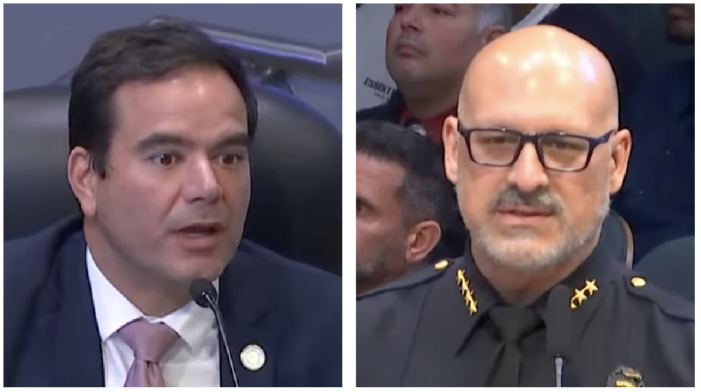
Miami Commissioner Ralph Rosado wants to make sure the city does not hand out keys, proclamations or ceremonial honors to anyone with a criminal conviction — or anyone under a civil, criminal or ethics investigation.
Not convicted. Not charged. Not found liable or guilty of anything.
Just under investigation.
Under RE.19 on Thursday’s City Commission agenda, an unresolved investigation would apparently be enough to keep someone from receiving a key to the city, a proclamation or another official recognition.
That is breathtakingly broad. Anyone can file a complaint. Political enemies file complaints all the time. Investigations can remain open for months or years before ending without any finding of wrongdoing.
So the obvious question is not merely what Rosado’s resolution says. It is: Who is this aimed at?
Read related: Miami names street after disgraced ex commissioner — in unanimous vote
At first glimpse, one might suspect it was inspired by former Miami Commissioner Miguel Gabela’s controversial effort to name a portion of a 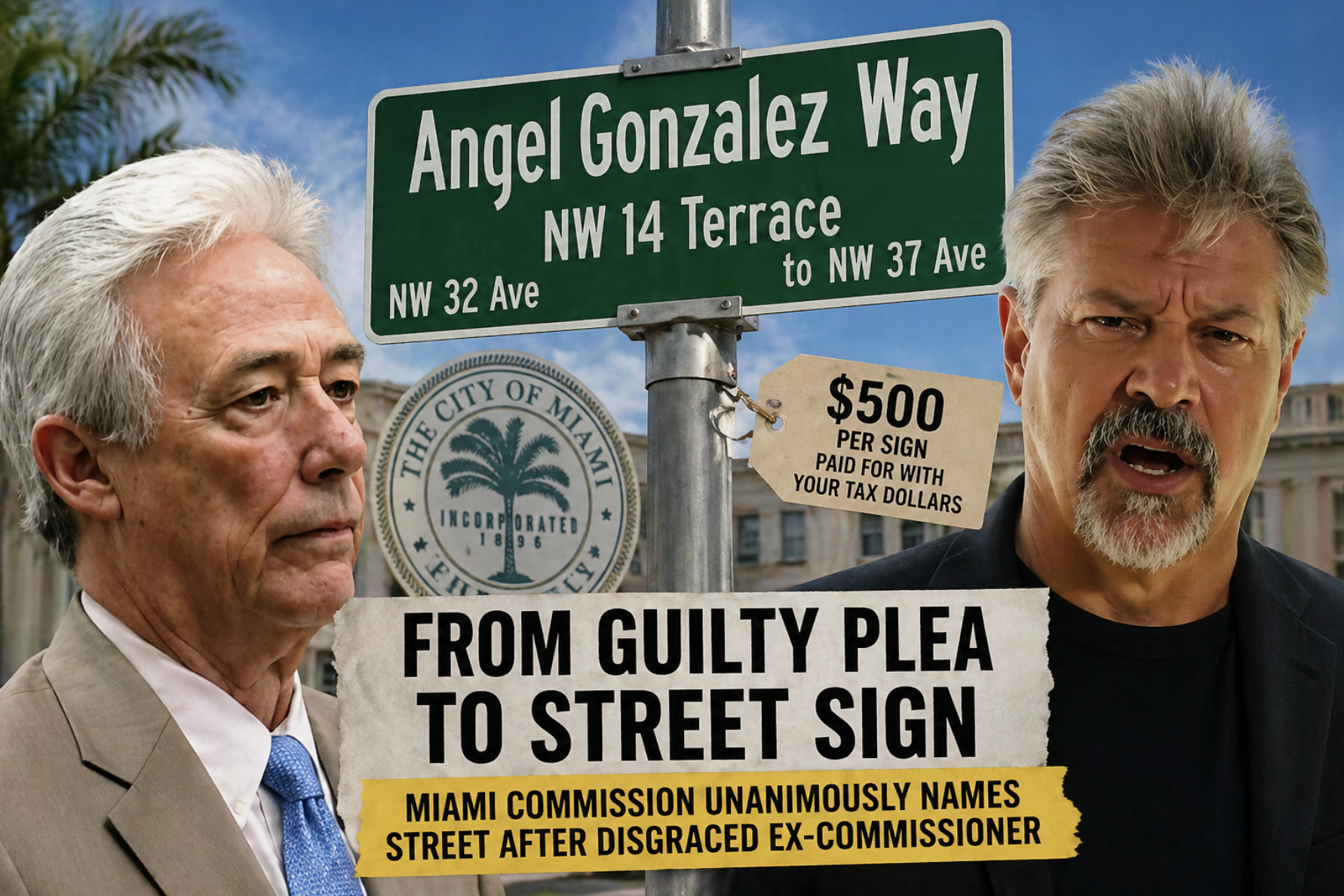 city street “Ángel González Way” after the former D1 city commissioner, who in 2009 pleaded guilty to a misdemeanor tied to abusing his position — by getting his daughter a no-show job with a city contractor — was sentenced to probation, resigned from office, and agreed not to run again for a bit. This was after he pleaded guilty to voter fraud in the 1997 election that was overturned by the courts.
But no, it’s not about that. Because Rosado’s item does not explicitly include honorary street names. It covers keys, proclamations and “other ceremonial recognitions,” but does not specifically say that someone who is under investigation cannot have a street named after them.
Why the curious omission? If the purpose is to protect the integrity of city honors, why would honorary street designations — which can last much longer than a proclamation — be excluded?
Could it be because Rosado voted in favor of the Ángel González naming? ¿Será because Rosado wants Gabela’s vote?
Las malas lenguas suggest the measure may be intended to block any possible recognition of former Miami Police Chief Manuel “Manny” Morales, whose name is increasingly mentioned as a potential candidate for the District 4 commission seat as a challenge to the incumbent.
Political Cortadito has not independently confirmed that Morales has decided to run — or that he formally requested a key to the city or a “Manny Morales Day.” But sources say some type of recognition had been discussed.
And, if this resolution passes, Morales has a potential obstacle: an ethics complaint containing a long list of allegations involving a private nonprofit corporation called the “Miami Police Foundation.”
Corporation records show the nonprofit was registered in February 2025 using Miami Police Department headquarters — 400 NW Second Avenue — as its principal address. The records identify Morales as president and his wife, Olga Morales, as vice president. A private business associate was listed as the organization’s registered agent. The corporate filing is available through Sunbiz.
The complaint alleges that the use of police headquarters as the nonprofit’s address improperly connected a private organization to a publicly owned facility. It also raises questions about whether Morales disclosed the organization and any outside business activity as required under Miami-Dade’s outside-employment rules.
Those are allegations — not findings.
Read related: Ralph Rosado says Miami Police Chief Manny Morales will run against him
The complaint reportedly also alleges that Morales accepted meals, alcohol or entertainment from a business associate affiliated with the 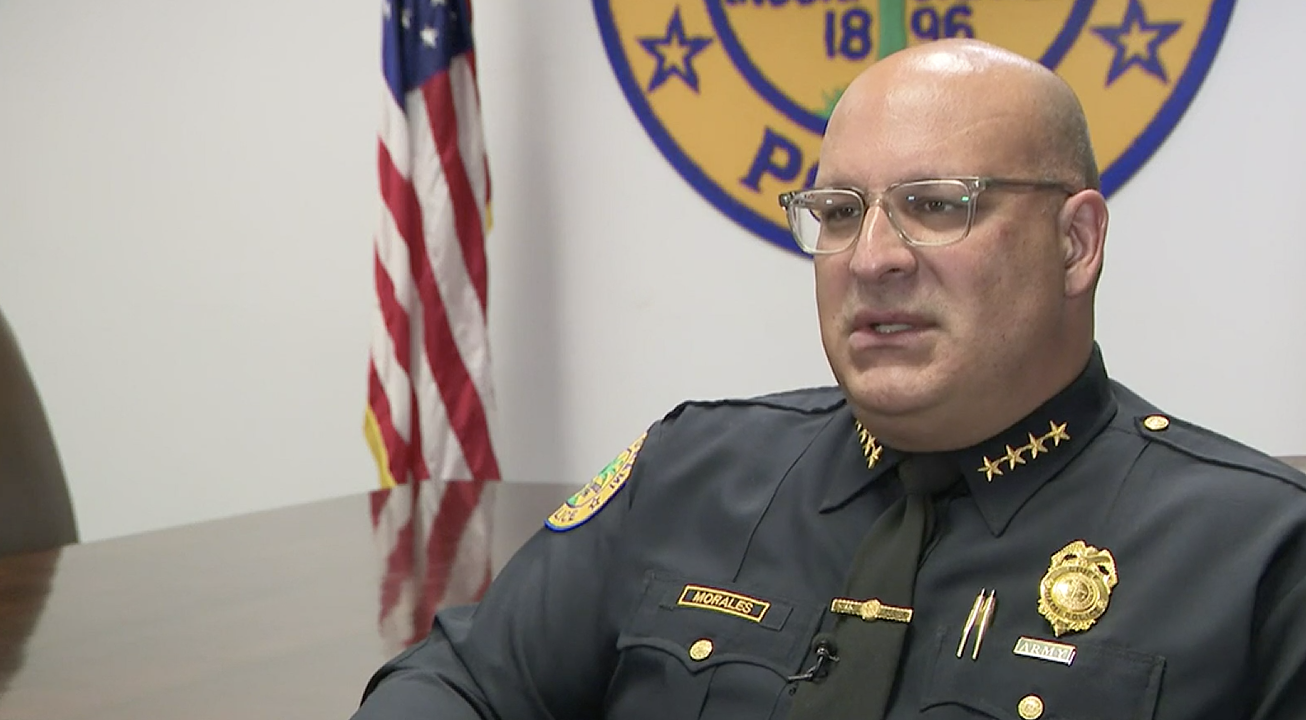 foundation. It questions whether that relationship could violate ethics rules governing gifts and the use of public office.
Again, allegations. Not proven violations.
The most consequential accusation involves Motorola Solutions and a multimillion-dollar police-technology procurement. The complaint alleges that Morales advocated for the company while his wife had a previous professional relationship with it and raises questions about whether anyone connected to the nonprofit could benefit.
There has been no public finding establishing that Morales, his wife or the foundation benefited from the procurement or committed any violation. The allegations would require documentary evidence and an independent investigation before conclusions could responsibly be drawn.
The complaint called on the city to investigate, examine Morales’ outside-employment disclosures, review any affected procurements and refer the matter to the Miami-Dade Commission on Ethics and Public Trust. Earlier reporting confirmed that questions surrounding the foundation surfaced as the city was preparing to replace Morales as police chief. WLRN reported on the controversy during the chief-selection process.
And that brings us back to Rosado’s resolution.
Is there actually an active investigation into Morales? Which agency opened it, when was it opened, and what exactly is its scope?
Those details matter because Rosado’s legislation uses the words “under investigation.” A complaint sitting in someone’s inbox is not necessarily an investigation. Neither is an accusatory email — no matter how lengthy or alarming.
Read related: The Miami police chief, a private foundation, and a very public complaint
If no agency has formally opened a case — and has anybody seen Inspector General Tony Diaz around? — Morales may not even fall within the policy. If an investigation has been opened, however, the timing of  Rosado’s proposal becomes much more interesting.
It could amount to a legislative stopgap: No key to the city. No proclamation. No “Manny Morales Day.”
At least not until somebody decides whether there was anything there in the first place.
In a statement from his office, Rosado told Political Cortadito it was just good public policy.
“A key to the city or an official proclamation carries the name and reputation of the city of miami and the should mean something,” Rosado said. “We should have a responsible vetting process to ensure these honors are bestowed on individuals who reflect the values of our community — not criminals or individuals facing serious investigations.
“Protecting the integrity of these honors also protects the integrity of our city,” he said.
But the same thing could apply to street names.
Rosado should explain Thursday what prompted the measure, whether any particular proposed honoree inspired it and why honorary street names were apparently left outside the prohibition.
Because ordinances and resolutions are rarely drafted in a vacuum at Miami City Hall.
And this one looks suspiciously like it may already have somebody’s name engraved on it.
The commission meeting begins at 9 a.m. Thursday at City Hall, 2900 Pan American Drive, and can also be seen live on the city’s website as well as on its YouTube channel.
Please take a moment to support the independent, government watchdog reporting like what you have read here with a contribution to Political Cortadito by clicking here. Ladra thanks you for your support.

Is Miami’s ‘no keys under investigation’ proposal aimed at Manny Morales? added by Ladra on
View all posts by Ladra →