
For decades, judicial races in Miami-Dade have been the political equivalent of background music. They’re on the ballot. Most voters know they’re there. Few know or care much about the candidates.
This year, that changed.
The race for 11th Judicial Circuit Court Group 67 has evolved from a little-noticed contest into one of the most closely watched judicial campaigns on the county ballot — not because judges suddenly became celebrities, but because the race now sits at the intersection of experience, national politics, campaign strategy and the growing question of whether judicial elections are becoming just another partisan battlefield.
That’s a remarkable turn for a race that, in another year, might barely have registered outside the legal community.
Read related: After the April Fool’s fake-out, six real Miami-Dade judicial races remain
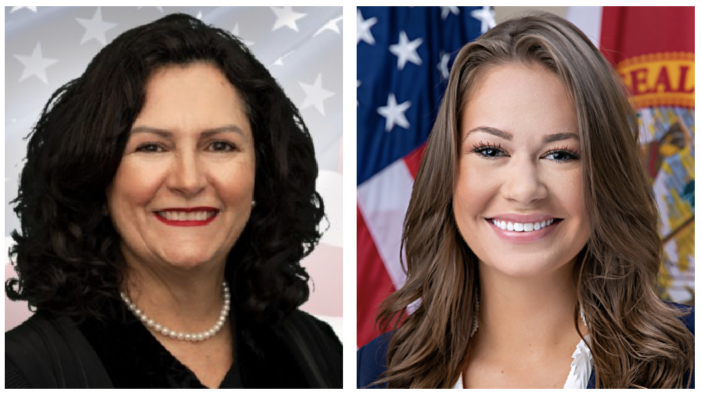
Judge Mavel Ruiz has served on the circuit bench since 2015 after a 20-year career that included service as an assistant public defender. Challenger Destiny Alvarez, who used to be Destiny Goede just a few months ago, is a younger attorney who joined her father’s small practice in Naples after being admitted to The Florida Bar in November of 2020, and says she is running to give voters a choice and serve the public.
On paper, that’s a straightforward solid-incumbent-vs-eager-newbie-challenger race.
In reality, it has become a lot more.
The contest has gained attention — and, indeed, probably exists — because the proposed Donald Trump presidential library at Miami Dade College  landed in Ruiz’s courtroom last year. Ruiz initially entered an order blocking the transfer of the property — citing that the required public notice had not been met — while the litigation proceeded. She later dissolved that injunction, and ultimately dismissed the lawsuit.
Like it or hate it, she followed the law both when she entered the injunction and when she dismissed the lawsuit.
But afterward, the Miami Dade College Board of Trustees — a bunch of Republicans appointed by Gov. Ron DeSantis — successfully sought to have Ruiz disqualified from further proceedings in the matter, arguing she appeared personally biased toward the plaintiff after she hugged the well-known local historian and civil rights activist in court following a hearing.
The litigation attracted attention well beyond Miami because it involved President Trump’s proposed presidential library, instantly transforming what otherwise would have been a local land-use dispute into a case followed by national political observers. And local consultants and MAGA loyalists, por supuesto, who saw an opportunity.
Alvarez has publicly said the Trump library litigation was not the reason she decided to run. Yeah, right. It’s just a happy coincidence?
Supporters of Ruiz, and she has a lot, have argued that the case elevated Ruiz’s profile, made her vulnerable and changed the political dynamics surrounding what ordinarily would have been a routine judicial election. They note that having a judge whose decisions are not politically inspired is an asset — and a blessing.
Read related: Proposed Trump library and hotel in downtown Miami is hit second lawsuit
Whatever the motivation, one fact is difficult to ignore: most sitting circuit judges never draw challengers at all. This election cycle, dozens of Miami-Dade judges automatically retained their seats because no opponent qualified to run against them. Competitive judicial races remain the exception rather than the rule.
That reality has made Group 67 a proxy for a broader discussion inside Miami’s legal community: What experience should voters reasonably expect from someone seeking a circuit court judgeship?
Florida law establishes the constitutional qualifications necessary to serve as a circuit judge. And the bar is incredibly súper low.
Under Article V, Section 8 of the Florida Constitution, a person is eligible to serve as a circuit judge if they (1) have been a member of The Florida Bar for the preceding five years, (2) are a registered voter in Florida and (3) reside in the judicial circuit when they take office.
That’s it. Notice what’s not required:
- No minimum number of jury trials.
- No minimum number of bench trials.
- No courtroom experience requirement.
- No requirement to have ever served as a prosecutor or public defender.
- No requirement to have ever represented a client in court.
- No requirement to have been a partner in a law firm.
So when people debate qualifications in this race, they’re really debating what voters should expect, not what the Constitution requires. That’s an important distinction. Because the Constitution says five years in The Florida Bar is enough to qualify. It doesn’t say a word about trying a jury case, presiding over a hearing or writing a judicial order. Whether voters think that’s enough experience to entrust someone with deciding murder cases, multimillion-dollar business disputes and child custody battles is another question entirely.
The few informed voters who don’t just check off a name because it’s Hispanic or a female or the first one on the list — those who care in other words — tend to emphasize years in practice. Or judicial temperament. Or trial experience, management ability, legal scholarship or community involvement.
Ruiz’s supporters have highlighted her years on the bench and her prior experience as a public defender, arguing that presiding over thousands of matters and handling numerous jury and bench trials provides practical experience that should be required to serve as a judge.
Alvarez’s campaign has focused on political connections and attack ads. But the candidate herself talks about fresh leadership and offering voters an alternative, because contested elections strengthen judicial accountability. She’s not wrong about that.
Read related: Somebody really wants Miami-Dade Judge Mavel Ruiz off the bench
The Miami Herald Editorial Board endorsed Ruiz, concluding that her judicial experience outweighed whatever menial shortcomings she had while also discussing issues including a prior Florida Supreme Court reprimand that Ruiz took responsibility for. They also observed that Alvarez had not yet tried a single case before a judge or jury. Not one. She is a desk lawyer. That contrasts sharply with Ruiz’s lengthy trial and judicial chops.
Outside the courtroom, the campaign itself has become more recognizable than most judicial contests.
Independent political spending, campaign messaging and online attacks have drawn unusual attention for a judicial race, raising broader questions about whether judges are increasingly finding themselves caught in the same political machinery long associated with legislative and executive offices.
Text messages directing voters to a website version of a campaign mailer, with bold headlines, ominous graphics and a steady drumbeat of criticism 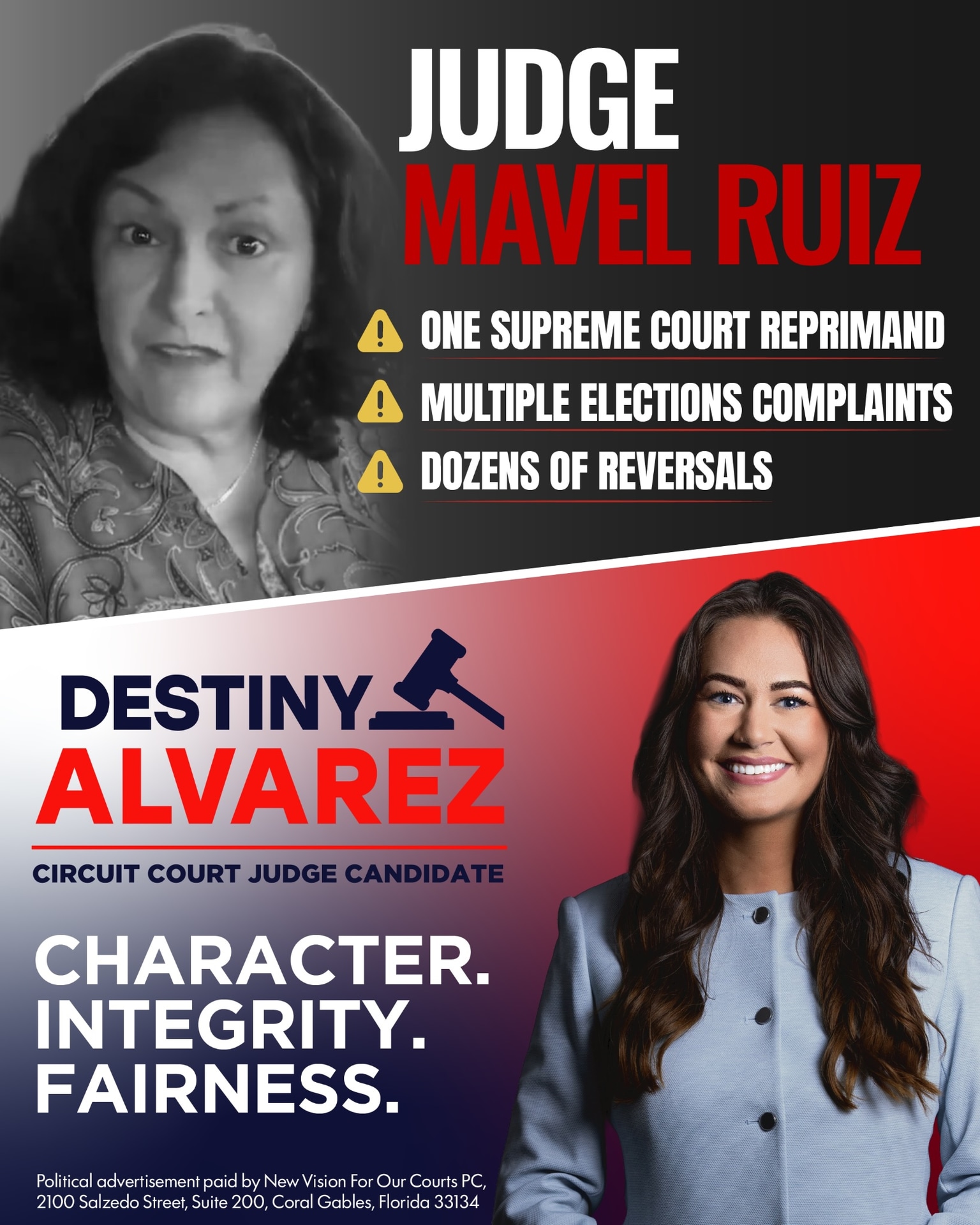 that feels less like judicial education and more like opposition research put on the internet. At least one message was paid for by New Vision for Our Courts, a political action committee funded by other conservative Republican PACs funded by more PACs.
But the attacks just hammer home the fact that Alvarez simply has no track record at all to run on.
Then there is the ballot itself.
Judicial races have long been considered “low-information elections,” where many voters know little about the candidates beyond the names printed on the ballot. Florida law permits candidates to use their legal names, and Alvarez’s ballot name complies with those rules. Even so, campaign consultants have long acknowledged that surname recognition can influence voting behavior, particularly in nonpartisan judicial contests where voters often have limited information. And records show that Destiny Goede turned to Destiny Goede Alvarez and then just Destiny Alvarez months ago, deciding years later to take the last name of her husband, Nicholas Alvarez, a lobbyist for Comcast that she married in 2023.
Read related: Trump library and the ‘name game’ will feature in Miami-Dade judicial race
None of that suggests anything improper. It does, however, illustrate how even seemingly small campaign decisions can become subjects of discussion when voters have little else on which to distinguish candidates.
Perhaps the most striking aspect of Group 67 isn’t any single campaign mailer, endorsement or television advertisement.
It’s that a race for a circuit court seat—a contest that, in most years, would generate little more than a candidate forum and a few legal endorsements—has become a conversation about judicial independence, political polarization, campaign strategy and the role of experience on the bench.
Whatever happens on Election Day, this much seems clear: judicial elections in Miami-Dade no longer exist entirely outside the gravitational pull of modern politics.
And if this race is any indication, the era of sleepy judicial campaigns may itself be headed for the law books.
This kind of independent, government watchdog reporting is crucial to transparency and democracy. And more so every day. Help shine a light on the darker corners of our community with a contribution to Political Cortadito. Click here. Ladra thanks you for your support.

How a sleepy Miami-Dade judicial race woke up as one of its most political added by Ladra on
View all posts by Ladra →
I’ve been blessed to do more high profile complex ligation than most people, and think judicial temperament and open mindedness are what we need in all judges. I’ve known Destiny through non Florida real estate deals with her dad, and since before she started law school. I thought from minute I got to hang around her in a setting having zero to do with law, politics or business, that she was a most remarkable young person and completely open minded, intellectually honest no matter the topic, and just a superb human being. I don’t doubt her opponent is too, but am positive she is and will embrace service with a passion if elected. Perry R Sanders, Jr
Anybody who has been in court in front of Mavel Ruiz knows how much of a disaster she really is. You may have all the evidence to win your case against a defendant that has nothing and Ruiz will ignore it and rule in favor of the defendant. I have experienced this myself. My vote is with Destiny!!!
I take 20 years experience over 5 years of a desk job any day!!
I will honestly say that I met Destiny Alvarez and I am convinced. The 11th judicial circuit needs this woman as a judge. We also need her to quickly move forward and run for chief judge and once and for all get rid of the cliques and favoritism that we have in this circuit today. The level of leadership that Destiny carries in her backpack is above and beyond any of the last Chief Judges we’ve had in decades after Chief Judge Farinas. Join me in moving Destiny Alvarez into the chief judge seat as soon as possible after being elected. Who is making the support group with me? 🙌
Is this Nick Alvarez, the candidate’s husband? And lobbyist? Now working to make his wife chief judge already when she hasn’t even been elected? That would be important to disclose here.
And sir, you are counting chickens way too early.
Love, Ladra
In a recent forum the challenger has said that
said she worked for Grey Robinson. Is that true?
Her husband has ties with local and state politics, obviously he is a lobbyist…. I have seen some stuff on social media, Alvarez seems like a fine person, but come on 5 years of minimum experience.. and she is sending attack mailers about being overturned?
Money quote: “Alvarez had not yet tried a single case before a judge or jury. Not one.”
Please let’s stop calling it a presidential library and call it what it is. It’s a commercial hotel and office high rise tower disguised as a presidential library.
Every headline or mention of the project should refer to it as such and not potentially mislead readers.