

A new political action committee led by Miami activists announced Tuesday the launch of a citizen-led petition to amend the city’s charter, “aiming to create a more representative, accountable and transparent local government.” The petition proposes three changes that would go to voters: holding city elections in even years, expanding the size of the city commission, and adding fair district guidelines.
“We all deserve real representation in government. Too often, our neighborhoods and residents go unheard,” said Mel Meinhardt, a lead organizer for the Stronger Miami PAC and co-founder of One Grove Alliance — which formed in the wake of the illegal and invalidated 2022 redistricting of Miami that cut Coconut Grove into three districts.
“Voters should choose politicians, not the other way around,” Meinhardt said in a statement. “This amendment will reduce political corruption by ensuring districts are not drawn to benefit any specific party or candidate — a fair redistricting system that accurately represents our city.”
Read related: Coconut Grove residents are ignored as Miami carves up D2 in redistricting
A federal judge already ruled in favor of the ACLU and a group of Grove residents who sued after the redistricting and has ordered the city to establish a process, which should include a committee, for redistricting in the future. This petition, Meinhardt told Political Cortadito, would ensure that the mission of that process and committee is to draw fair districts and not gerrymander for partisan or other reasons, like keeping incumbents in office. “It gives the committee direction,” he said Tuesday.
The PAC was filed its paperwork with the city clerk March 28 and is chaired by another Miami activist, Anthony “Andy” Parrish, another redistricting critic who served on the city’s planning and zoning board.
To get the proposed charter changes on the on the November ballot, the PAC needs to have 26,000 signed petitions by sometime this summer. That’s 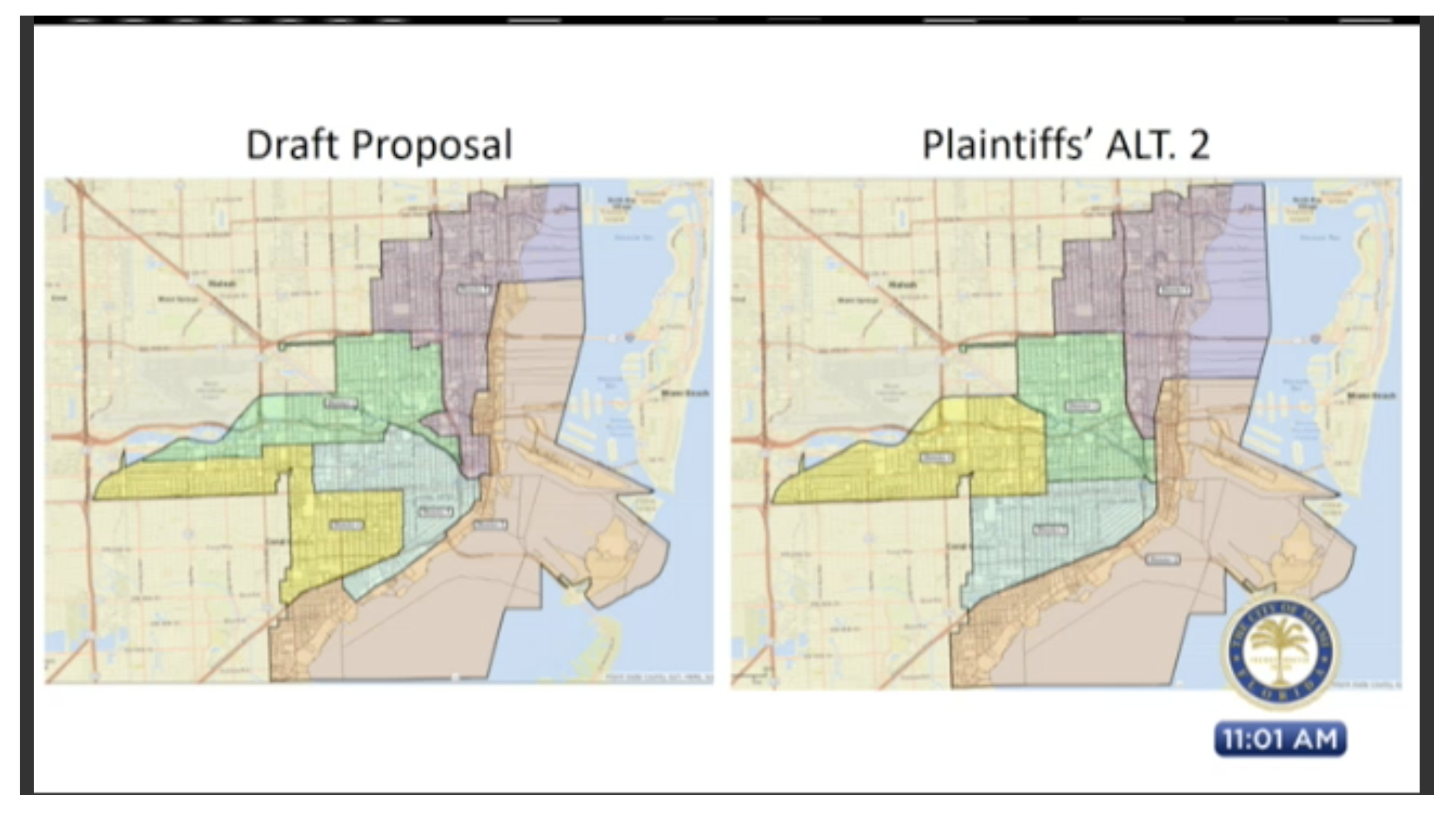 a hard haul. A coalition of groups — which includes Engage Miami, One Grove, and Florida Rising — are getting members to collect signatures.
The petition also aims to divide the city into nine smaller districts, rather than the five there are now, and move the election from odd years to even years that coincide with the state and national elections, to both reduce city costs and increase participation. These changes would make the city government more representative and elections more accessible, the activists say.
“In the 2023 elections, fewer than 16,000 people voted in a city of nearly half a million,” said Rebecca Pelham, executive director of Engage Miami, in a statement from the PAC.
“This means a very small number of people are making important decisions that impact everyone in the City. We need a system that genuinely represents all of us so residents have a real voice,” Pelham said. “Moving city elections to even years when other statewide elections are held will encourage more people to participate in local elections and be involved locally.”
There’s a question about whether or not this would extend the terms for the electeds who are there when the change comes. It seems that it would. But the activists don’t know about that. And there might be some backroom movement on the commission, anyway, to get that change of year on a ballot as well, but before the November election, to extend the terms of the mayor and Commissioner Joe Carollo (more on that later).
The smaller districts could also drive up turnout because they not only put elected officials closer the constituents they serve, but also create a dais that is harder to influence because three votes are easier to buy than five.
“The solution to the pollution is dilution,” Parrish told Ladra, using a tried and true environmental slogan to describe the Miami political climate. “We definitely have pollution,” he said.
He wold go even further, requiring each commissioner to work out of a district office. “Instead of having them all at Melreese, which is where they are going,” he said, referring to the former Melreese municipal golf course that is going to become a real estate complex with soccer stadium and a new city administration building in it.
 Meinhardt said it was illogical that the city has not changed its representation since it was founded 100 years ago, while the population has exploded. “It’s only getting acceleratingly worse,” Meinhardt said. “I looked around the country for best practices. We’ve got like 90,000 citizens for every commissioner. The average in well-run cities is more like 40,000.”
Read related: Miami should have more commission districts for fairness, not fewer of them
Ladra advocated for more districts two years ago when the redistricting kerfluffle led then District 1 Commissioner Alex Diaz de la Portilla to suggest eliminating districts completely.
Miami is the 43rd-largest city in the U.S., according to the 2020 Census, and the core of the nation’s eighth-largest metropolitan area. But cities of comparable size normally have more districts and more electeds.
Atlanta has a population of 498,715, or just about 30,000 more people than Miami. But Atlanta has 15 city council members — 12 elected in districts and three at large. Long Beach, California, just a little smaller than Atlanta and a little bigger than Miami, with a population of 466,742, has nine district council members. The city of Oakland, which is a little smaller than Miami, with 440,646 residents, has seven district council members. The city of Tampa, pop. 384,959, also has seven districts.
Esto no le conviene a los politicians who are there now. They like having the influence that comes with being one of three votes.
That’s why this is a citizen-driven initiative — because the electeds would never go for this. In fact, Ladra fully expect a campaign against it.
If you like what you read on Political Cortadito, please consider making a contribution to support the independent, government watchdog journalism on this website. Thank you!

Petition aims to add Miami commission districts, change election to even years added by Ladra on
View all posts by Ladra →
[…] Read related: Petition aims to add Miami commission districts, change election to even years […]
[…] Read related: Petition aims to add Miami commission districts, change election to even years […]
[…] Read related: Petition aims to add Miami commission districts, change election to even years […]
[…] Read related: Petition aims to add Miami commission districts, change election to even years […]
Mike Hepburn is right. The overhead for commissioners and their massive unqualified staffs is too great a burden for taxpayers. $44 Million for overpaid commissioners and their unofficial/official campaign staffs is not fair. Doesn’t Chistine King have 15 on her staff? Joe Carolllo’s crimes have cost the taxpayers $6 Million so fat?
I actually agree with Mr. Elvis Cruz point of view on this issue. I know this ballot initiative is derived from a good place but if you go this route first, you will be putting the cart before the horse and our people will get run over by the current political structure that’s in play.
The issue that we are facing in the City of Miami, is the major Civic Empowerment Gap that exists with our residents. We must unify to fix this problem FIRST, by raising the Consciousness of our Citizens, so the vast majority can see the value of being involved and understanding how their government works and how to work it. We need to lean into cultivating people power in numbers by creating strong Neighborhood Associations, Citizen Academies, Public Campaign Financing mechanisms, Participatory Budgeting initiatives, etc. So, our Citizens have access to the knowledge and skill set needed to activate their Democracy.
Just increasing the Commission from 5 to 9 Commissioners when we already spend $24,551,000.00 on covering these Commissioners Salaries and Operational cost will balloon our City Budget for Commissioners to $44,191,800.00 a year. I don’t know about you but there’s so many better ways we can utilize our Taxpayers Dollars.
Just switching our election to Even Years instead of keeping it where it is now – just dilutes our messaging power and will widen the gap even further at this time because the foundational education component for the vast majority of our City of Miami residents is not there yet. Our City of Miami Election and Initiatives will be located towards the end of the ballot; our Mayoral and Commissioners Elections and ballot initiatives will be thrown into a pot of so many other races including high profile and not; and we would just be hoping that the majority of our residents are doing their homework on all of the candidates, judges, ballot questions, charter amendments, etc. Before they vote.
Look… We conducted a survey of over 10,000 City of Miami Households this year and 92% of the respondents indicated that when they voted in the November 2024 General Election – they did not totally understand everything that they voted for or against. In particular, the survey respondents mentioned that they did not have solid background information on multiple races, candidates and their stances on the issues. The majority of the respondents mentioned they had no idea who the Judges were on the ballot, and 80% of the respondents could not correctly name or select their assigned elected officials based on their own address.
Heck… 77% of the survey respondents did not know the difference between living in the City of Miami and Miami Dade County.
Just increasing Commissioners from 5 to 9 does not fix this. Moving our Elections to Even Years at this time does not fix this either. The only thing that I can support on the ballot initiative at this time is the Fair Redistricting mandate.
To my fellow residents here in the City of Miami – we have some serious work to do to fix our Democracy, so that it works for all of us. I truly do admire the effort of this initiative but implementing all of these initiatives at the same time without changing the current climate in our city first – will hurt the working class people in my city more than help us.
Michael A. Hepburn, M.S.Ed.
The next Mayor of Miami
michaelhepburn.com
Commissioners are just too corrupt. Keon Hardemon and now Christine King force the taxpayers to pay for 11-12 employees. All these employees do is work on the re-election campaigns for the elected officials. Corruption.
Elvis Cruz makes excellent points. There have been sometimes only 1 commissioner who votes against horrible deals. Think Manny Reyes as the single No vote against Francis Suarez / Jorge Mas / Emilio Gonzalez scheme to kill Melreese Park. We saw Ken Russell voted Yes to kill Melreese Park.
Is increasing the number of commissioners from five to nine really a good idea?
With the current system, if the good guys want to stop the bad guys from doing something bad, they only need three commission votes.
(By ‘good guys’ I mean concerned citizens who understand the importance of protecting our quality of life. ‘Bad guys’ are those who would harm our quality of life, usually through over-development.)
But if the number of commissioners is increased to nine, the good guys would then need five votes, not three.
Yes, the same math would apply to the bad guys, but consider this:
How successful have the good guys been at winning elections?
How organized are the good guys in each commission district?
How well do the good guys compete against candidates backed by big developer money?
In Miami, campaign contributions to candidates from special interest groups and their Political Action Committees are legal, even though they are a cancer on the core of our democracy.
Developers and their associates give political contributions because they want to buy influence, not because they care about keeping our streets safe, our parks well-maintained and our garbage picked up.
As a result, we, the citizens of Miami, essentially have a government of developers, for developers, by developers.
When was the last time the Miami City Commission voted down an up-zoning request?
If we haven’t been able to find and elect only five commissioners to protect our quality of life, how are we going to find, elect, and monitor nine?
If the city commission is expanded, won’t the developers simply run their own candidates and finance their campaigns? Won’t it become harder for the good guys to prevail?
More is not always better.
Be careful what you ask for.